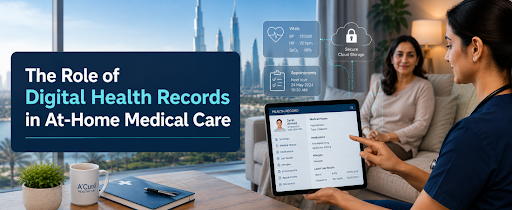
Something has changed quietly in how medical information moves between patients and the professionals treating them. Digital health records are slowly replacing paper files, sticky notes, and half-remembered symptoms. It sounds like a small administrative fix, but it is actually changing how at-home medical care works day-to-day, especially in a city like Dubai, where more people are choosing care that comes to their doorstep rather than a clinic.
Why Records Matter Even More Outside a Clinic
Inside a hospital, everything a patient needs is usually in one place. Every department can pull up the same file. Take care out of that building and into someone’s living room, and suddenly that centralized system disappears. This is exactly why accurate, easy-to-reach records matter more once care moves home, not less.
Think about a doctor at home Dubai patients call for a follow-up visit. If that doctor can pull up the patient’s history in seconds, the visit starts on solid ground. Without that, the appointment often turns into the patient trying to recall symptoms, old prescriptions, and past treatments purely from memory, which rarely goes perfectly.
What Actually Goes Into a Digital Health Record
A good record is not just a name and a diagnosis stapled together. It usually holds the details that make treatment safer and faster.
- Past medical history and earlier diagnoses
- Current medications and known allergies
- Notes from previous home visit doctor consultations
- Lab results and diagnostic reports
- Ongoing treatment plans and upcoming follow-ups
How This Plays Out During a Doctor on Call Visit
The Visit Starts Faster and More Informed
When a doctor on call shows up, having the patient’s file ready changes the whole tone of the visit. Instead of piecing the story together from scratch, the doctor can glance through recent lab work and past prescriptions before even saying hello.
Patients Stop Repeating Themselves
Anyone managing a chronic condition knows the fatigue of explaining the same history over and over. Digital records take that weight off the patient, so the conversation can focus on what is happening right now instead of retracing old ground.
Fewer Medication Mistakes
When a physician can see a full, current medication list, the risk of a bad drug interaction or an accidental double prescription drops sharply. This matters a great deal for elderly patients juggling several medications at once.
Keeping Care Consistent Across Several Visits
Home healthcare is rarely a one-time thing. A patient recovering from surgery, or managing a long-term illness, might be seen by a few different professionals over several weeks. Digital records make sure that whoever shows up next, whether it is a different nurse or a different shift entirely, is working from the same accurate picture.
This kind of consistency matters most for patients who need long-term monitoring, where small shifts in symptoms or vital signs need to be tracked over weeks, not judged one visit at a time.
What About Privacy?
Naturally, moving health information online raises a fair question about privacy. A dependable at-home medical care provider keeps records encrypted, limits access to authorized staff only, and follows local data protection rules.
If you are choosing a home healthcare provider, it is completely reasonable to ask how your information is stored and who can see it. A provider with nothing to hide should be able to answer that clearly.
When It Really Counts: Urgent Situations
There is rarely time for a long background check during an urgent call. If someone reports sudden chest discomfort, a spiking fever, or a bad reaction to medication, the doctor showing up needs context right away, not after ten minutes of questions to a worried patient or family member.
This is where digital records earn their keep. A quick look at allergies, existing conditions, and recent treatments lets the visiting doctor make faster, safer calls the moment they walk in, and in some situations, that speed genuinely matters.
Less Room for Miscommunication
People under stress do not always remember things correctly. A patient might forget a recent diagnosis or mix up the name of a medication entirely. A digital record takes the guesswork out of the equation by giving the treating professional verified information instead of a stressed recollection.
What This Shift Really Reflects
Digital health records are not just a nice add-on bolted onto existing services. They point to a bigger change in what people now expect from healthcare, especially as more patients choose treatment outside the four walls of a traditional clinic.
As home healthcare keeps growing across Dubai, the providers who do this well are usually the ones investing in secure, accessible systems, rather than relying on scattered paper files and memory.
What Patients Can Expect Going Forward
As more providers adopt this technology, patients should start noticing a few practical changes in how their care is handled.
- Quicker access to medical history during new visits
- Less need to repeat the same information every time
- Better coordination between doctors, nurses, and specialists
- Clearer, more consistent tracking of long-term conditions
Final Thoughts
Digital health records are not the flashiest part of doctor at home, but they are becoming one of the most important. As more people choose home visit doctors and on-call consultations over a trip to the clinic, having accurate, accessible records will keep making that care not just convenient, but genuinely well-informed.