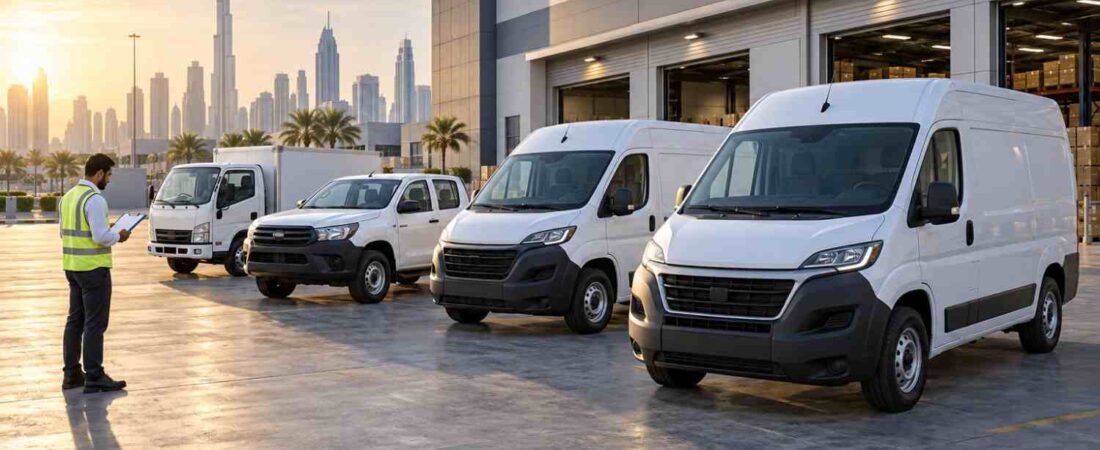
Dubai’s business growth is creating a practical transport challenge: companies need enough vans, pickups and staff vehicles to serve demand, but they do not want permanent fleet costs to run ahead of signed work. The question is particularly important for e-commerce sellers, maintenance contractors, construction suppliers, caterers, event operators and service companies whose workload can change from month to month.
Official indicators show the scale of the private-sector pipeline. Dubai Chambers recorded 292,486 active member companies in 2025, up 13.2% annually, and 71,830 new member companies. At the federal level, the Ministry of Economy and Tourism said in January 2026 that UAE SMEs account for nearly 95% of companies and more than 85% of private-sector jobs. When thousands of firms are starting, expanding or winning new contracts, vehicle capacity becomes a growth constraint as well as a cost.
Why fleet demand rarely moves in a straight line
A retailer may need additional delivery vans during Ramadan or a major promotion. A facilities company can win a twelve-month contract that requires technicians across several sites. A contractor may need pickups for mobilisation and fewer vehicles after handover. Buying for the peak can leave idle assets later; buying for the average can create missed deliveries when demand rises.
Flexible access provides a middle path. A core fleet can cover predictable work while extra vehicles are added for contracts, seasonal peaks, breakdown cover or route tests. The value is not simply avoiding purchase. It is shortening the time between demand appearing and transport capacity becoming available.
Match the vehicle to the job before comparing prices
Cargo and delivery vans
An enclosed van protects parcels, food equipment and tools from weather and reduces visibility of the load. Compare internal dimensions, payload, door configuration, loading height, tie-down points and temperature requirements. A larger van is not automatically better if it is difficult to park or enters low-utilisation routes half empty.
Pickup trucks
Pickups can suit tools, site materials and equipment that benefit from an open load bed. Check cab configuration, payload, permitted use and how cargo will be secured. The vehicle and driver must be appropriate for the load; rental access does not remove operational safety obligations.
Crew and passenger vans
Staff movement requires attention to legal seating capacity, seat belts, boarding, route length and driver scheduling. A crew vehicle selected only by seat count may be uncomfortable or inefficient on long daily routes. Companies should evaluate passenger safety and journey time alongside price.
Light commercial vehicles
Compact commercial vehicles can be effective for city service calls and smaller deliveries, especially where parking and access are difficult. The correct choice depends on the largest normal load, not the largest imaginable load. Exceptional jobs may be handled by a temporary larger vehicle.
Where rental flexibility creates operational value
QuickLease presents commercial vehicle rental in Dubai options for cargo vans, pickups, crew vans and light commercial vehicles, with monthly terms and service support described on its current fleet page. Businesses should request live availability and a written quotation for the exact vehicle class, term, mileage and usage.
The strongest use cases are measurable. A new delivery route can be tested for eight weeks before a permanent fleet decision. A replacement van can protect service levels during repair. A project team can add vehicles for the contract period. A company can compare productivity across two vehicle sizes using real route data instead of forecasts.
Ownership pathways for stable core vehicles
Rental is not the answer for every role. A vehicle running a proven route at high utilisation for several years may justify an ownership pathway. QuickLease also lists car lease without down payment in Dubai options for eligible vehicles and applicants. Such a structure can preserve initial cash, but the business should model the total cost and confirm which commercial uses and vehicle types qualify.
A blended fleet can therefore be more rational than a single policy. Own or work toward ownership for predictable, strategic assets; rent for variable capacity and specialised needs. Review the allocation quarterly as contracts, routes and maintenance history change.
The fleet service-level agreement that protects revenue
Commercial transport should be managed through a service-level checklist. Define maintenance intervals, booking lead time, support hours, roadside response, replacement conditions, delivery and collection, authorised drivers, geographical use, mileage, accident reporting and escalation contacts. If temperature control, tail lifts, toolboxes or tracking are required, specify them in the quotation and handover record.
Downtime needs a financial value. Estimate the gross margin, labour cost or penalties exposed when a vehicle is unavailable for one day. This turns replacement support from a vague benefit into a decision variable. A slightly higher contract cost may be economical if it materially reduces operational interruption.
Measure fleet productivity, not fleet size
Useful indicators include productive kilometres, drops or jobs per route, revenue per vehicle day, fuel per completed task, on-time completion, unplanned downtime and vehicle utilisation. Measure by role and route. A vehicle that travels fewer kilometres may still be more productive if it completes high-value technical visits.
The UAE’s Ministry of Economy and Tourism reported AED 806 million in government and national-company contracts awarded to national SMEs in 2025, 38% higher than in 2024, while the 2026 forum offered AED 2.445 billion in tenders. Not every business will participate in government procurement, but the broader lesson is clear: companies need scalable operating capacity to convert opportunities into deliverable work.
Run a controlled vehicle trial before scaling
When a business is uncertain about vehicle size or route economics, a short controlled trial can provide better evidence than a spreadsheet alone. Assign one vehicle to a defined route or project, record daily load, stops, fuel, driver feedback, parking delays, and unused capacity, then compare the results with the original assumptions. The trial should be long enough to include normal busy and quiet days. Businesses working with logistics experts such as Khaleej center can also benefit from practical insights that support better fleet planning and more informed operational decisions.
Use the findings to refine the specification before adding more units. A smaller van may complete city routes faster; a larger vehicle may reduce the number of trips on bulk deliveries. Driver comfort can affect productivity on long shifts, while easy loading can shorten every stop. These operational differences often outweigh a small monthly price gap when repeated across hundreds of jobs.
A disciplined expansion sequence
First, define the job and vehicle specification. Second, test demand with flexible capacity. Third, collect route, utilisation and downtime data. Fourth, decide which vehicles are now core. Fifth, compare long-term rental, lease-to-own and purchase using the same cost horizon. This sequence delays irreversible spending until the operation provides evidence.
Commercial fleets should make growth easier, not create pressure to chase work simply to cover idle vehicles. By connecting fleet commitments to signed demand and measuring the cost of downtime, Dubai businesses can increase capacity while keeping financial and operational risk visible.
About QuickLease
QuickLease Car Rental LLC provides vehicle rental and leasing options in Dubai and the UAE, including daily, weekly and monthly rentals, commercial vehicles and lease-to-own plans. Availability, eligibility, rates and contract terms should be confirmed directly for the selected vehicle and period.