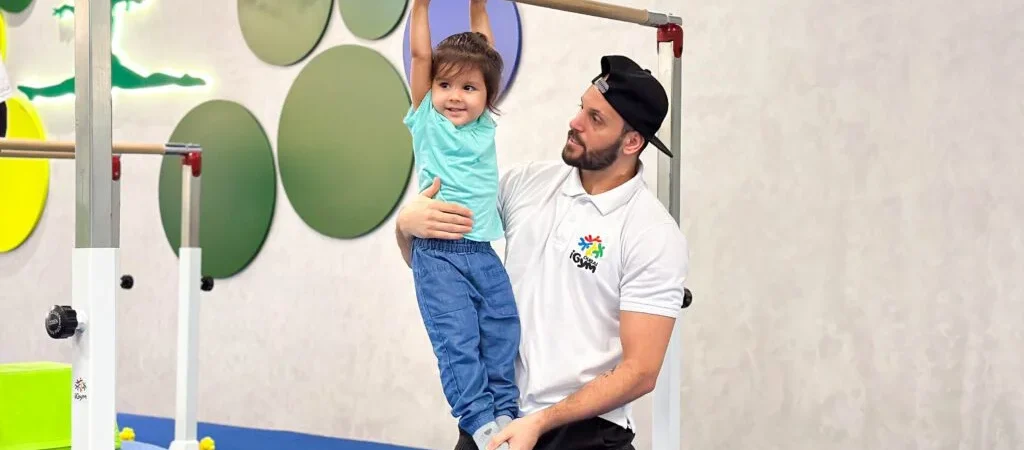
Most parents ask about gymnastics as a sport before they ever ask about a lesson. Fair enough. But once you’ve decided it’s worth trying, the question that actually matters is a smaller, more useful one: what does a class look like once you’re in it, and how do you tell a good one from a mediocre one? Because gymnastics lessons in Dubai differ a lot more between clubs than parents expect, and it’s the shape of the lesson, not the size of the gym or the polish of the website, that decides whether your child gets anything out of it.
What a well-run lesson actually looks like
A proper lesson isn’t kids doing cartwheels for an hour while a coach watches. It has a rhythm to it, and you’ll notice it if you sit in on one.
It starts with a warm-up, five or ten minutes of joint mobility, light stretching, maybe a movement game to get everyone loose. This part gets skipped by rushed programmes, but young joints and tendons genuinely need it before any tumbling starts.
Then comes the actual skill work, usually twenty to thirty minutes of it. Kids rotate through stations, floor, beam, sometimes bars or trampoline, and a good coach has them working on one or two specific skills rather than throwing everything at them at once.
Somewhere in there is conditioning, short bursts of core and grip strength, usually dressed up as a game for the younger kids so it doesn’t feel like exercise.
And it should end with a cool-down and a quick recap, where the coach tells the child what actually improved that day. This last bit sounds minor, but it does more for a child’s motivation than most parents give it credit for.
If a class goes straight from warm-up into free-for-all tumbling, that’s usually a sign the coach is minding a group rather than teaching anything.
Group size matters more than almost anything else
This is honestly the biggest quality gap between one gymnastics programme and another in Dubai, bigger than the décor, the equipment, or the mall it’s in. A room with fifteen kids and one coach is supervised play. A room with six or eight kids and a coach who’s actually spotting each one on new skills is a lesson. So ask, plainly, how many children will be in the specific class your child is joining. Not the club’s general “we keep classes small” line, the actual number for that time slot.
Which type of lesson fits your child
A one-off trial lesson is worth taking no matter what. Most academies, i-Gym included, offer this, and it tells you more in forty-five minutes than any brochure will.
Recreational weekly lessons, one or two sessions a week, low pressure, progress measured in months, are the right starting point for almost every child.
Semi-private or private lessons make sense for a child working on one specific skill, catching up after a break, or who just does better one-on-one before joining a group.
And multi-discipline lessons, a mix of artistic gymnastics with some trampoline or acrobatic work, suit younger kids who haven’t shown a clear preference yet.
How to tell it’s actually working
Gymnastics is easier to track than most kids’ activities because the skills are specific, not vague. In a lesson that’s working, you’ll see your child naming what they’re working on rather than just saying “gym stuff.” You’ll hear about small, steady improvements rather than sudden big leaps, which usually just means a coach is rushing things. The coach themselves should be able to tell you exactly where your child sits in a skill’s progression, not offer a vague “doing great.” And your child should be excited before class, not just relieved after it. Parents looking for trusted family resources through Al Khaleej Center often value programs that prioritize measurable progress, supportive coaching, and a positive learning environment for children.
If a lesson isn’t clicking after a fair trial period, the fix is usually the format rather than the sport itself. A child who’s a bit lost in a group of twelve might do noticeably better in a smaller class, or a few weeks of semi-private sessions before rejoining a group.
Questions worth asking before you book
Skip whatever’s on the website and ask the coach or the front desk directly. How many kids will actually be in this lesson, at this time slot? What skill is my child expected to be working on in the first month? Is there a trial lesson, and what does it really include? What happens if we miss a class, is there a make-up? And does the same coach teach it every week, or does it rotate?
A club that can answer all of this without hesitating is showing you how it actually runs its lessons, not how it markets them.
Bottom line
A gymnastics lesson is only as good as its structure and its group size, not its address or its Instagram feed. If you can, watch one from the sidelines before you commit, or just take the trial class yourself. i-Gym runs trial lessons across its Palm Jumeirah Mall, Triple 777 (Jumeirah 3), and Dubai Creek Harbour branches, which is really the easiest way to see how a lesson actually runs before signing up for a term.